
The Dagger of Champaneri
Part II: The Sand of Pavagadh
2026-10-29 · ABikram Mondal
The temporal dislocation lasted no longer than the snap of dry bamboo, but the toll on the physical body was terrifying. Rudra felt an icy nausea claw at his throat, and inside the crystal pommel of the dagger, a visible measure of the glowing golden sand had dissolved, reduced to grey ash that pooled at the base of the sphere. The weapon was not an inexhaustible spring; it was a lamp burning an ancient, finite oil.
Knowing that in two seconds the tile would creak beneath him in the forward timeline, Rudra shifted his weight to the damp masonry wall and lunged sideways before the Mughal officer could turn. With a swift, muffled blow from the pommel, he struck the Mughal captain behind the ear, dropping him senseless to the stone floor before a single war-cry could be uttered.
Malik Zia-ud-din drew a hidden jambiya from his belt, his eyes wide with fanatical fury. "You fool! You do not comprehend what you hold in your peasant hands! That blade was recovered from the ruins of Alamut when Hulagu Khan flattened the mountain of the Assassins! It belongs to the masters of time!"
"It belongs to no man who sells his garrison in the dark," Rudra replied in dry, measured Gujarati. "The copper spikes are already hammered into the north rock face. Humayun's men are ascending."
Outside, the pre-dawn horn sounded from the lower battlements—not the celebratory horn of the defenders, but the sharp, three-note staccato of alarm. The Mughal vanguard had begun their ascent sooner than expected.
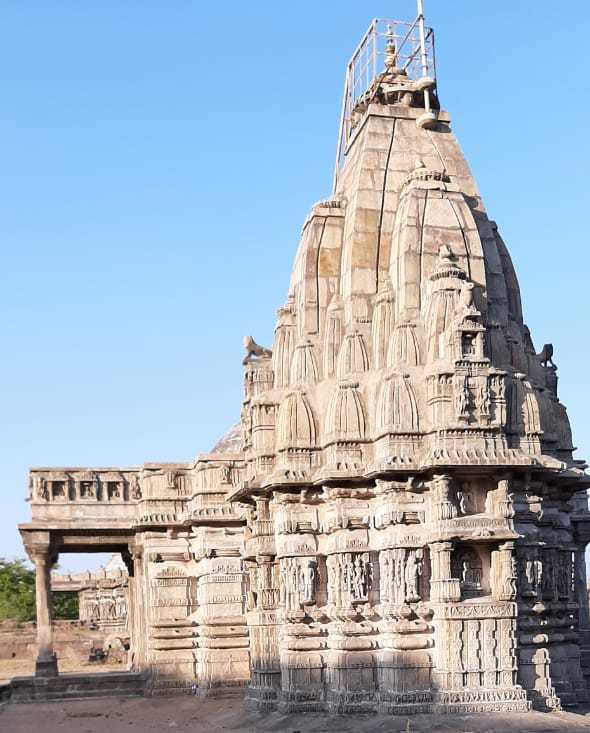
Sprinting across the upper terrace, Rudra scaled the spiraling carved stone pillar of the Kalika Mata shrine, reaching the highest parapet of Pavagadh. Below him, in the pale indigo light of dawn, three hundred imperial climbers were hauling themselves up the sheer basalt chimney using seventy iron and brass spikes driven into the rock—led by Emperor Humayun himself, renowned for his reckless personal valor.
If the northern bastion fell while the garrison slept, twenty thousand souls in the upper town would be slaughtered before sunrise. But if Rudra dropped the iron braziers of burning pitch down the chimney, he would seal the doom of the climbers while igniting the wooden armory directly beneath his own feet.
Zia-ud-din rushed up the narrow spiral stair, brandishing a matchlock pistol. The hammer fell—a plume of sulphurous smoke and lead whistled through the dawn air, tearing directly through Rudra's left ribcage.
As the searing agony flared and the cold wind of the cliff began to pull him backward into the eight-hundred-foot abyss, Rudra's fingers closed around the pommel bezel for the final time. He did not pull himself back to safety; he calibrated the reverse arc of time to the moment Zia-ud-din had raised the weapon.
The amber vortex ripped through the sky. Clouds over the plains of Baroda whipped backward in reverse spiral. In that miraculous, backwards-flowing second, Rudra deflected the matchlock barrel with the flat of the ancient blade. The bullet struck the heavy iron anchor-cable of the siege lift, severing the counterweight. With a thunderous crash that shook the foundations of the mountain, the great iron portcullis slammed down into the cliff chute, shearing away the climbing ropes and burying the iron spikes under fifty tons of dry volcanic rubble.
The surprise siege was broken. Down below, the Mughal horns called an immediate, chaotic retreat back to their encampment.
On the parapet, the last grain of golden sand inside the crystal sphere turned to pale, inert ash. The lapis lazuli hilt cooled, its inner light extinguishing forever into a simple, quiet dagger of Persian steel. Malik Zia-ud-din lay bound in chains at the feet of the Rajput commanders, his grand treachery laid bare before the rising sun.
Rudra stood at the parapet, looking out over the emerald expanse of Gujarat stretching toward the Gulf of Khambhat. He slipped the inert dagger into his waistband. Time, once bent and rewritten by the vanity of kings and sorcerers, had resumed its quiet, unbroken march forward—just as the river flows, indifferent to the stones that seek to turn its course.