
The Dagger of Champaneri
Part I: The Citadel of the Wind
2026-10-29 · ABikram Mondal
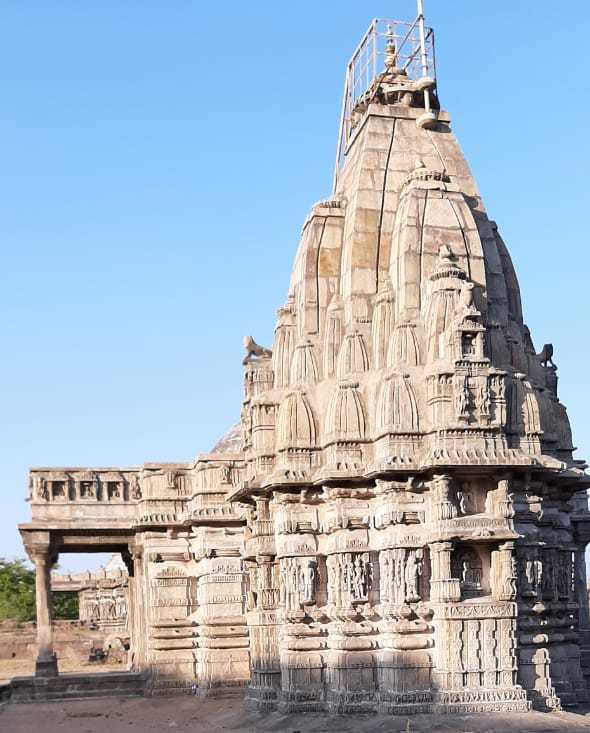
The monsoon of 1535 had not yet arrived, and the sheer eight-hundred-foot basalt cliff of Pavagadh rose out of the Gujarati dust like the petrified tooth of an ancient titan. Below the precipice, sprawling across the foothills, the royal city of Champaner lay under an iron vice. The young Mughal Emperor Humayun had encamped his artillery and cavalry in the dry acacia scrublands, their white silk tents shimmering like salt marshes in the dry summer heat.
Above, in the upper citadel where the Rajput defenders and the remnants of Sultan Bahadur Shah’s garrison held the ramparts, water was more precious than silver coin. But Rudra Pratap Vaghela was not looking at the water reservoirs. He was crouched three hundred cubits above the abyss, his fingers hooked into the narrowest fissures of the vertical volcanic stone, listening to the creak of copper spikes being driven into the cliff face two terraces below him.
Rudra was neither a general nor a court poet. In the official muster of Pavagadh, he was recorded simply as an Akhara-Nayaka—a master of acrobatics, wall-climbing, and reconnaissance, trained in the old Mewari discipline of silent movement. When an ordinary man saw an unclimbable wall, Rudra saw a stairway of microscopic ledges, cantilevered balconies, and rain-cut gutters.
For seven nights, something unnatural had been transpiring along the northern battlement. The Sultan’s prime minister, Malik Zia-ud-din—a man whose ancestry traced back to the silk cities of Khorasan—had ordered all sentries removed from the ruined cellars beneath the Daulat Khana. Every midnight, a faint, bioluminescent amber glow seeped through the arrow-slits above the cliff edge, accompanied by a sound like dry river sand rushing backward through an hourglass.
Slipping through an open drainage culvert that emptied into the void, Rudra dropped silently onto the stone flags of the subterranean armory. The chamber smelled of damp saltpeter and crushed saffron. At the center of the vaulted hall, set upon an octagonal ebony pedestal, rested a velvet-lined rosewood casket.
Inside lay a weapon that defied every canon of Indian smithing. It was a curved dagger, no longer than a man’s forearm, but its hilt was carved from a single piece of dark, luminous lapis lazuli, bound with spiraling filigree of celestial orichalcum. Where the pommel met the tang, a transparent crystal sphere was sealed with molten brass; inside the sphere swirled a dense, incandescent golden powder that moved against the pull of gravity, drifting upward toward the ceiling like living sparks.
Before Rudra could withdraw his hand, heavy boots echoed in the arched corridor. Two men entered: Malik Zia-ud-din, dressed in black brocade, and a tall, scarred officer bearing the imperial tiger-striped sash of Humayun’s inner vanguard.
"The spikes are hammered into the cliff below the jungle gate," the Mughal officer murmured, his voice low and guttural. "By dawn, three hundred imperial climbers will scale the north face without a drum being sounded. Humayun has pledged the treasury of Ahmedabad to you in return for the blade."
Zia-ud-din smiled, his eyes glinting in the oil lamps. "The treasury is irrelevant. When the Khan-i-Khanan strikes, he will discover that the blade does not merely cut flesh—it reverses the error of the cut. With the Sands of Nishapur in my hand, no dagger from an assassin or court conspirator can ever reach my heart."
A loose tile under Rudra’s heel clicked—a fraction of a millimeter of movement. But in the dead stone cellar, it sounded like the cocking of a matchlock.
The Mughal officer spun, his Persian scimitar clearing the scabbard in a silver blur. Zia-ud-din lunged toward the casket. In that single, breathless breath, Rudra did not hesitate. Vaulting off the stone wall with the coiled velocity of a leopard, he snatched the lapis hilt from the pedestal. As the steel scimitar bit toward his shoulder, his thumb instinctively pressed the ornate brass bezel set into the pommel.
A blinding flash of golden dust tore through the chamber. The world shrieked. The torch flames froze, turned purple, and rushed backward like sucked breath. Rudra felt the cold stone yank his limbs backward—and suddenly, he was standing once more behind the drainage archway, two seconds before he had stepped on the loose tile, his heart pounding against his ribs, the heavy, singing dagger cold and real in his bare hand.