
The Cartographer's Shadow
Historical (Part 2/3) - ABikram Mondal
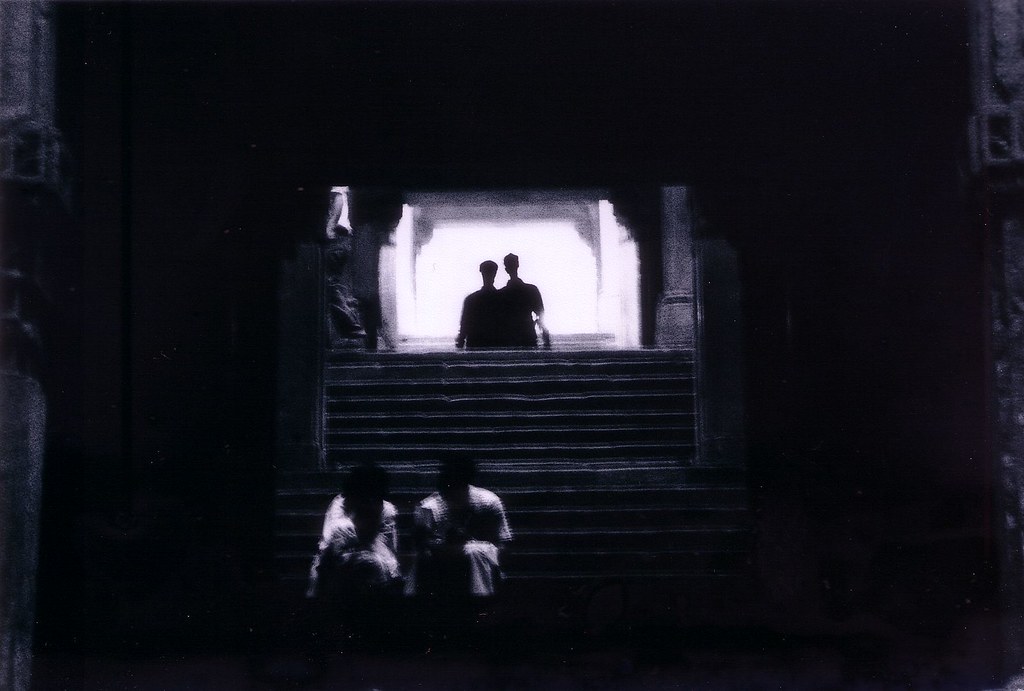
The morning sun, already fierce, beat down on the golden-hued sandstone of the Adalaj Stepwell. Rajan, his grandfather’s worn leather satchel slung across his shoulder, felt a prickle of anticipation and unease. The stepwell, a five-story architectural poem, descended into the cool embrace of the earth, its intricate carvings telling stories of gods, goddesses, and daily life. But Rajan was searching for a different story, one whispered by a forgotten symbol.
He descended, the air growing cooler with each flight of steps, the outside world fading into a distant hum. The distinct scent of damp stone and something else, something metallic and ancient, filled his nostrils. He moved past the chhatris and mandapas, his eyes scanning the hundreds of niches and pillars, searching for the stylized Ashoka Chakra, the one with the extra spoke. He felt a profound connection to his ancestors, not just the cartographers, but the very artisans who had chiselled these stories into stone, perhaps hiding their own.
It took him almost an hour. Deeper in the well, in a particularly shadowed alcove on the fourth level, where water once would have reflected light onto the dark stone, he found it. Faint, almost imperceptible beneath centuries of dust and grime, the symbol was etched into a small, flat stone panel. It was smaller than he expected, no bigger than his palm, tucked away as if meant to be overlooked. He ran his fingers over the carving. The extra spoke on the Chakra felt oddly rougher, as if it had been added later, or with a different tool.
He pulled out the ancient globe. He rotated it until the corresponding symbol on its surface aligned with the one before him. A soft click echoed in the stillness. A small, almost invisible seam appeared on the wooden globe, and a tiny drawer, no wider than his thumb, slid open. Inside lay a single, rolled parchment, brittle with age. His heart hammered. This was it. The first seal.
Carefully, he unrolled the parchment. It was a fragment of a map, not of land, but of something else entirely. A series of interconnected dots and lines, resembling constellations, yet clearly terrestrial. Intricate script, in an archaic Gujarati he barely recognized, flowed around these symbols. He could make out a few words: “Jal Devi,” “Gupt Marg,” “Hira-Kund.” Water Goddess. Secret Path. Diamond Pool. But most strikingly, at the center of this fragment, was a perfectly rendered image of a lion, not the Asiatic lion of Gir, but a mythical beast, winged and crowned, its eyes glowing. And beneath it, a single, etched word: “Dwaraka.”
Dwaraka. The ancient, submerged city, fabled capital of Lord Krishna. A city of myth and legend, whose very existence was debated by modern archaeology. What could it have to do with the Sabarmati, or a secret path, or a diamond pool? Rajan felt a chill, despite the rising heat. This wasn't merely about hidden springs; this was about something far older, far more profound. His grandfather's tales of 'secret cartography' suddenly felt less like whimsy and more like fragmented truths.
As he re-rolled the parchment, a shadow fell across him. He looked up, his breath catching. A figure stood at the top of the steps, silhouetted against the bright entrance. Too tall, too still. The sunlight glinted off something metallic in their hand. Not a weapon, but a strange, long-handled tool, like an ancient divining rod or a surveyor's instrument, its tip ending in a polished, dark stone. Rajan instinctively pressed himself against the cool stone wall, the parchment clutched tight. Had he been followed? Who else knew about this?
The figure began to descend, slowly, deliberately. Each step echoed with an ominous weight. Rajan could feel his pulse quickening. He knew, with a certainty that settled cold in his stomach, that this person was not here for the architectural beauty of the stepwell. They were here for what he had just found, or perhaps for him. He remembered the cryptic note: “The truth of the Sabarmati waits for those who seek with pure intent, and hides from those who would corrupt it.” Was this the 'corruption'? The rival scholars his grandfather had hinted at in his more paranoid moments?
He looked around wildly. There were other tourists, but they were mostly at the upper levels, marveling at the carvings, their voices a distant murmur. Down here, he was alone with this encroaching presence. The figure reached the third level, their face still obscured by shadow, but Rajan could make out the sharp, tailored lines of an expensive suit beneath a light cloak. This was no ordinary trekker or casual visitor.
Rajan made a decision. He couldn’t confront them, not here, not now. He had the parchment, the first clue. He had to escape, to decipher this new piece of the puzzle. He turned and swiftly ascended the steps on the opposite side, using the shadows and alcoves as cover. He moved with the agility of someone who had spent his life navigating the narrow alleys of Ahmedabad, his mind racing. The winged lion, Dwaraka, the secret path. These were not just clues; they were an invitation into a deeper mystery, one that clearly had guardians, or perhaps, hunters.
As he reached the upper levels, he risked a glance back. The figure was now at the fourth level, where he had been moments ago, their head slightly tilted, as if listening. Rajan froze. Had they heard him? Or were they merely sensing the lingering echo of his presence? He quickened his pace, blending into a small group of tourists near the exit. The sunlight felt blinding after the cool depths of the stepwell, but he welcomed its harshness. He didn't look back again, didn’t dare. He clutched the globe and the parchment, the weight of the ancient secret now feeling heavier, more dangerous than ever before. The truth of the Sabarmati was not merely hidden; it was guarded. And he had just announced his presence to its keepers.