
The Weaver of Forgotten Maps
The Fort's Silent Message
2026-08-27 · ABikram Mondal
The next morning, the dust motes dancing in the Salar Jung Museum’s archival light seemed to mock Arjun’s impatience. He had spent the night poring over every available text on Golconda Fort’s siege, cross-referencing military strategies, escape routes, and descriptions of the fort’s intricate water systems. Zubeida Begum’s words, “The Qila Ganth was often used to weave patterns that shifted, depending on the light, or how you held the fabric,” echoed in his mind. He needed to see the weaves again, not just in photographs, but in person, under different conditions, seeking those subtle shifts.
He secured special permission to access the Deccani Weaves collection, usually kept under controlled humidity and temperature. The curator, a man named Dr. Rathore who had initially dismissed Arjun’s theories, watched with a bemused tolerance. Arjun ignored him, his focus absolute. He held the largest fragment, a piece depicting what looked like a stylized bastion, up to the artificial light, then to a shaft of sunlight filtering through a high window. Nothing. He rotated it, changed his angle. Still nothing. Frustration began to prickle. Had Zubeida Begum been mistaken? Had he misunderstood?
He remembered her description of the knot: “a secret picture, only for those who knew to look.” What if it wasn't about light, but about touch, about interaction? He laid the fabric flat on a clean surface, his fingers tracing the patterns. The weave was dense, almost rigid. He pressed gently, feeling for any unusual give, any hidden seam. Then, he noticed it. A minute irregularity in the texture, almost imperceptible, along the edge of what he interpreted as a fortification wall. It wasn't a flaw, but a deliberate alteration. He pressed slightly harder, carefully, and felt a minute, almost imperceptible give, as if a thread had been released from tension.
As his fingers followed this subtle line, the woven pattern seemed to subtly warp, the bastion’s outline elongating, and a new, finer line emerging within it, almost like a faint vein. It was a secondary layer, woven in a different, finer thread, only visible when the primary weave was gently manipulated. It was not a shift of light, but a physical interaction. The 'shifting pattern' was a tactile secret. He traced the emerging lines, carefully, his breath held. They weren't flowing rivers or roads as he’d initially thought, but highly specific, angular conduits. He pulled out his modern map of Golconda Fort, focusing on the historical plans of its water systems.
The lines on the fabric, once manipulated, bore an uncanny resemblance to the karez, the underground water channels, that fed Golconda Fort. Not the major, well-documented ones, but a forgotten, smaller network near the Fateh Darwaza, an entry point frequently contested during the siege. This particular system, often overlooked in modern archaeological surveys, was mentioned in obscure Persian accounts as crucial for sustaining a small, hidden garrison within the fort’s outer walls. It was a lifeline, a secret artery.
Dr. Rathore, who had been observing Arjun with a growing, if still skeptical, interest, stepped closer. “What exactly are you doing, Mr. Arjun?”
“I believe I’m reading it, Doctor,” Arjun replied, his voice barely a whisper. “The map. It’s a map of the fort’s forgotten waterworks, specifically near the Fateh Darwaza. A hidden supply, probably for a strategic position during the siege.”
Rathore peered at the fabric, then at Arjun’s historical maps. “Extraordinary, if true. But a fragment of a textile map won't lead you to anything more than a dry pipe now.”
“Perhaps not directly to water, Doctor. But to a forgotten passage, a hidden chamber. These karez systems often had access points, small subterranean rooms for maintenance, or even for temporary shelter during attacks.” Arjun pointed to a specific intersection on the fabric, where several lines converged, revealing a small, circular motif. “This. This looks like a junction, perhaps an access well or a small cistern.”
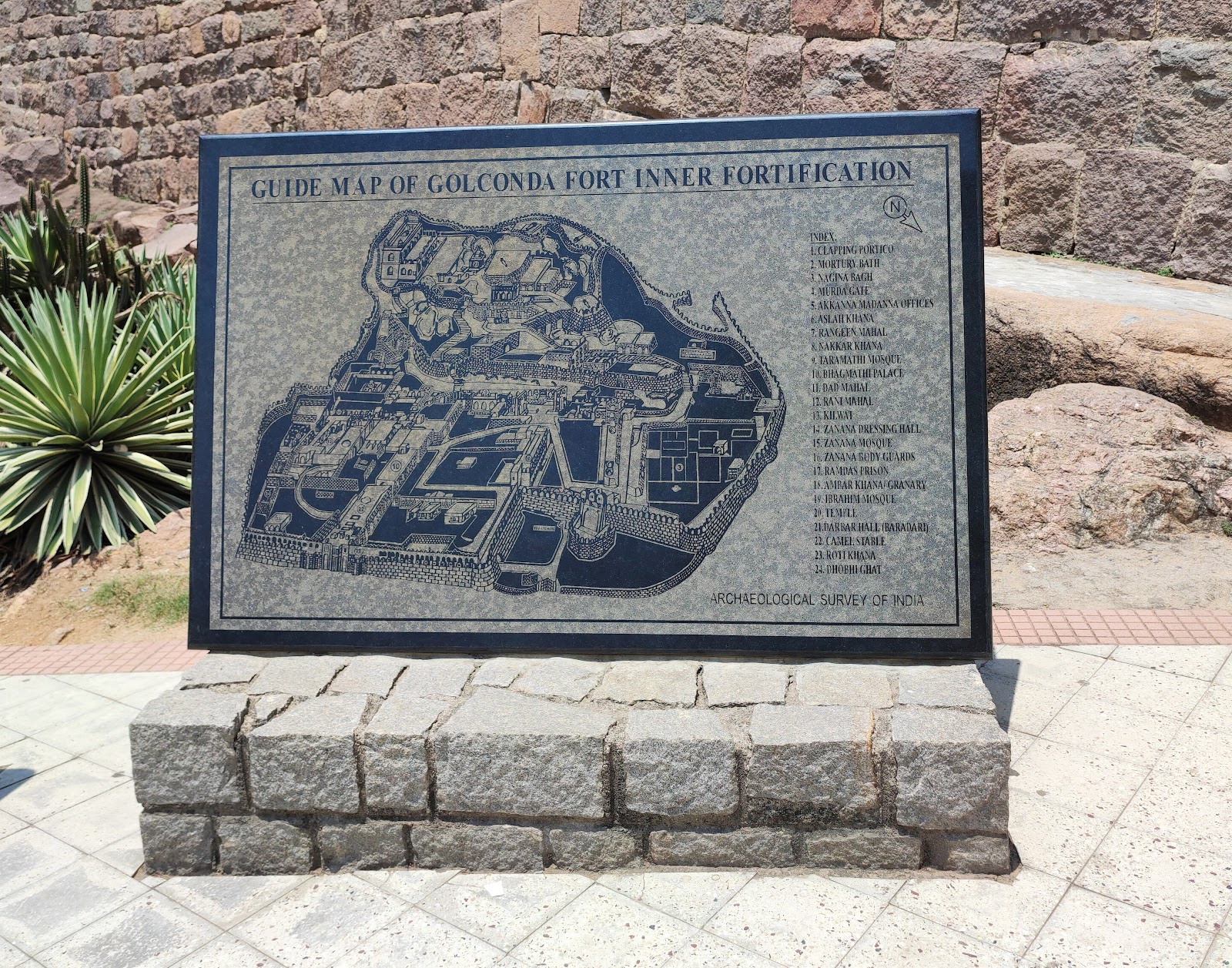
Armed with this new interpretation, Arjun wasted no time. He journeyed to Golconda Fort, the fragments carefully wrapped, a printout of the modern fort map marked with the karez system. The midday sun beat down on the ancient stone, baking the air. The Fateh Darwaza loomed, majestic and scarred by time. He navigated the bustling tourist paths, then veered off, using his map to locate the less-trodden areas where the forgotten karez system was believed to run.
He found the approximate location, a patch of overgrown scrubland near a crumbling outer wall, far from the main tourist circuit. There was no obvious entrance, no visible well. He knelt, his fingers sifting through the dry earth, feeling for any anomaly. He remembered Karim, the weaver, the secret cartographer. What would he have done? How would he have marked a hidden entry, known only to a select few, amidst the chaos of a siege?
He looked at the textile fragment again, focusing on the circular motif. It was subtle, not a prominent feature. He scanned the ground, then the wall. His gaze fell upon a single, oddly shaped stone in the crumbling wall, partially obscured by vines. It was larger than the others, and its texture was different, smoother, as if it had been worked with more care. He brushed away the dirt and vines. On its surface, almost worn away by centuries of weather, he discerned a faint, circular indentation, perfectly matching the motif on the textile.
His heart hammered. He pressed against the stone. It didn't budge. He felt along its edges, searching for a lever, a release. Nothing. He then remembered Zubeida Begum’s words about the shifting patterns, the tactile secret. He pressed his palm against the faint circle, then slid it clockwise, mimicking the motion he had used on the fabric to reveal its hidden lines. With a deep, grinding groan that vibrated through the ancient earth, the stone slowly receded inwards, revealing a narrow, dark opening. A rush of cool, damp air, smelling of earth and time, wafted out.
He shone his phone light into the darkness. A short, descending passage led to a small, circular chamber, clearly an access point to the karez. It was empty, save for the echoes of history. He stepped inside, feeling the weight of centuries settle around him. His light swept across the rough-hewn walls. There was no gold, no jewels, no grand treasure. But in a small, shallow niche carved into the stone, carefully preserved from the elements, lay another textile. This one was larger, unfurling to reveal a complete, masterfully woven map. It wasn't just a fragment, but the entirety of Hyderabad’s earliest, planned underground water systems, intricately detailed, with annotations in faded Persian script, outlining strategic points, flow rates, and even contingency plans for drought or siege.
Karim’s legacy. The complete map was a testament to the unparalleled ingenuity of the Qutb Shahi engineers, a blueprint for survival, woven into the very fabric of their world. It showed not just the karez, but also the locations of baolis, stepwells, and underground cisterns, all interconnected, a hidden network sustaining a bustling city. The true treasure, Arjun realized, wasn't a hoard of physical riches, but this profound knowledge, this quiet declaration of resilience and foresight. He stood there, the cool damp air on his skin, the ancient textile in his hands, feeling a deep, quiet satisfaction. He had found it. Not a map to wealth, but a map to understanding. He had brought a forgotten piece of India’s brilliant past to light, a silent message from ancestors, whispering of their genius, their unwavering spirit, woven into the very threads of time.