The Emerald Legacy: Curse of the Chandragupta
The Whispers of Kumhrar
2026-07-23 · ABikram Mondal
The next morning, the humid Patna air clung to Aruna like a shroud as she stepped out of the auto-rickshaw near the Kumhrar excavation site. The city thrummed with its usual chaotic symphony – auto horns, street vendors, the distant clang of construction. But here, at the periphery of the metro project, a different kind of silence pressed in, broken only by the rhythmic thud of pile drivers a few blocks away. The security around the site was unexpectedly tight, a makeshift barricade of corrugated iron and barbed wire, guarded by men in crisp uniforms of the Patna Metro Rail Corporation.
Chatterjee, looking even more dishevelled than usual, met her just inside the perimeter. His eyes, usually sparkling with academic enthusiasm, were shadowed and darted nervously. “Aruna. You came.”
“Of course,” she said, her gaze sweeping over the scene. Beyond the immediate fenced-off area, the colossal skeletal structures of the metro line stretched, a stark modern imposition on ancient ground. “Where is it?”
He led her through a maze of temporary shelters and equipment, past groups of labourers who eyed them with a mixture of curiosity and unease. Their hushed conversations, punctuated by the occasional Hindi word like 'shraap' (curse) and 'pret' (ghost), drifted on the wind. The air grew heavier, thick with the scent of damp earth and something else, something metallic and strangely cold, even in the midday heat.
They reached a deeper section, cordoned off with even more urgency. Below, in a massive pit shored up with timber and steel, lay the mouth of the chamber. It was a gaping maw, framed by ancient brickwork, far older and more sophisticated than anything previously found in Kumhrar. The metro’s tunnels, cutting deep beneath the Gangetic plains, had inadvertently intersected a forgotten world.
“We’ve only managed to clear a path,” Chatterjee whispered, his voice strained. “The corporation, they want it suppressed. To minimise delays. They’re already lobbying the archaeological department to declare it a minor find, move it, bury it.” He gestured to a stern-faced man in a hard hat who was observing them from a distance, a walkie-talkie pressed to his ear. “That’s Mr. Sinha, the project manager. He’s been a thorn in my side.”
Aruna ignored Sinha, her focus riveted on the chamber. A crude scaffolding had been erected, leading down into the dark. As they descended, the air grew noticeably colder, the light from the surface dimming, swallowed by the depths. The faint smell intensified, like old copper and something sweet, sickly.
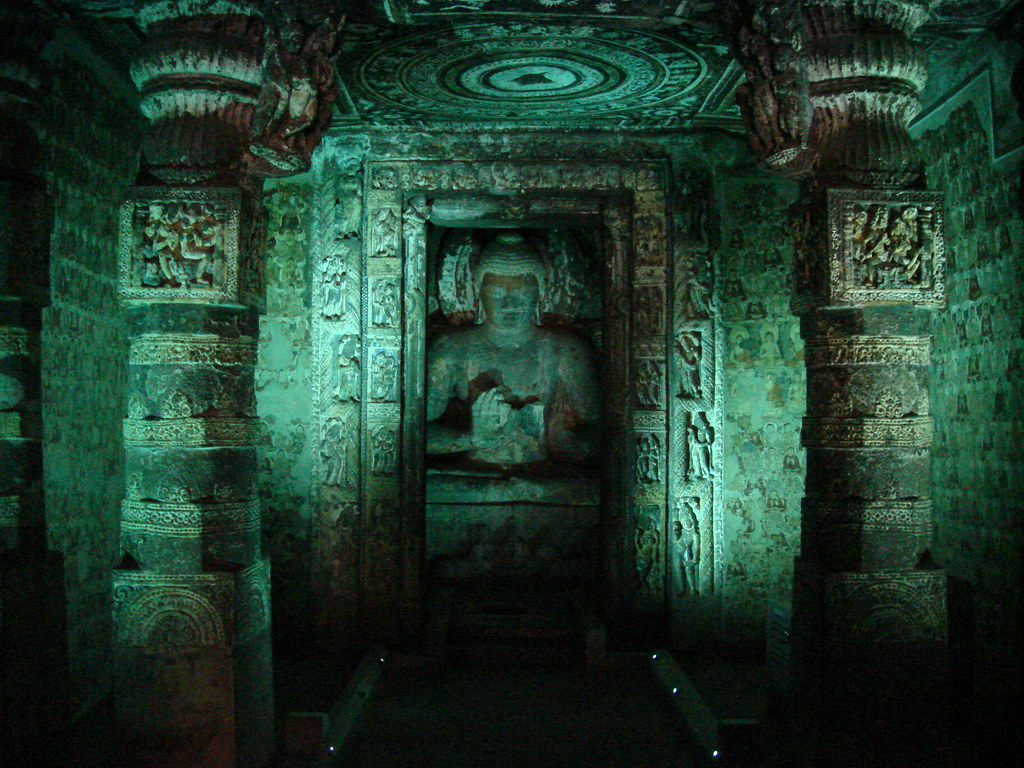
And then she saw it. Bathed in the stark glare of temporary floodlights, it filled the chamber, impossibly large. A statue, not of a deity, nor a king in triumph, but something archaic, primal. It was carved from a dark, almost obsidian-like stone, depicting a figure seated in a meditative pose, its features serene yet unsettlingly blank. Its scale was immense, easily twenty feet tall, and its surface was covered in intricate, almost microscopic carvings – symbols that Aruna had never encountered in any Mauryan iconography.
And in its forehead, where a third eye might be, pulsed the emerald. It was enormous, the size of a pigeon’s egg, perhaps larger, and its green was unlike any she had ever witnessed – not merely a colour, but a depth, a liquid light that seemed to draw the very essence from the air around it. It didn’t sparkle; it glowed, a soft, insistent throb that resonated within her own skull.
“It’s… breathtaking,” Aruna breathed, stepping closer, despite Chatterjee’s cautionary hand on her arm. The cold was more pronounced here, emanating from the statue itself. She reached out, drawn by an invisible current, but stopped short of touching it. The symbols on the statue’s surface seemed to shift, almost imperceptibly, in the periphery of her vision. Were they moving, or was it the flickering floodlights, playing tricks?
“The men… the accidents,” Chatterjee said, his voice hushed. “The one who touched it first, his hand swelled, then he fell from the scaffolding. Another developed a fever, raved about voices from the stone. And just this morning, a supervisor, Mr. Das, tried to chisel off a small piece for testing. He collapsed. Heart attack, they said. But he was only forty, Aruna, perfectly healthy.”
Aruna felt a prickle of unease, a cold sensation crawling up her spine that had nothing to do with the chamber’s temperature. Her scientific mind rebelled against the superstitious talk, but the evidence, however anecdotal, was piling up. “Has anyone tried to remove the emerald?” she asked, her voice tight.
“Sinha tried. He brought in a specialist team last night, quietly. They couldn’t budge it. It’s fused, somehow. Not set in, but a part of the stone itself.” Chatterjee shook his head. “It’s like it grew there.”
Aruna circled the statue, her archaeologist’s eye scanning every detail. The carvings, she now realised, were not merely decorative. They formed a complex, narrative sequence, depicting scenes of ancient Pataliputra, but distorted, almost nightmarish. Figures with elongated limbs, swirling patterns of what looked like cosmic energy, and at the centre of many scenes, a stylised eye, radiating lines of force.
Her fingers traced one of the symbols, an intricate spiral. A sudden, sharp jolt went through her, like static electricity, but deeper, resonating in her bones. For a split second, the chamber seemed to tilt, the floodlights to dim, and she heard a whisper – not in her ears, but inside her head, a chorus of ancient voices, faint and indistinct, like wind through dry leaves. She recoiled, her hand trembling. Chatterjee looked at her, his eyes wide with concern.
“What was that?” she asked, more to herself than to him. She rubbed her temples, trying to shake off the lingering sensation.
“The emerald,” Chatterjee said, his voice barely audible. “It’s not just an artifact, Aruna. It’s… alive. And it’s affecting everyone who comes close. I think it’s a trap. A warning.”
The whispers faded, replaced by the persistent thrumming of the emerald. Aruna looked at the giant stone eye, glowing with an internal fire. It was a repository of power, an ancient sentinel. And it had been deliberately hidden, sealed away for reasons far more profound than mere protection. This was no simple gem; it was a key, or perhaps a lock, designed to guard a truth that someone, two millennia ago, had deemed too dangerous to reveal. The metro corporation’s desire to bury it again, to forget it, suddenly felt less like bureaucratic obstinacy and more like an unconscious primal urge to escape something unfathomable. But Aruna could not escape. The emerald had called to her, and now, standing before it, she felt an undeniable pull, a terrifying curiosity that eclipsed all caution. What secrets lay entombed within its emerald gaze? And what price would she pay to unearth them?