
The Antikythera Mechanism: An Ancient Greek Marvel of Gears
A Wreckage in the Aegean
It was the year 1900. A sponge diving vessel, caught in a storm, anchored unexpectedly off the coast of Antikythera, a small island in the Aegean Sea. When divers went down, they weren't looking for ancient history, but what they found changed our understanding of it. Resting on the seabed, at a depth of roughly 45 meters (148 feet), was the scattered remains of a Roman-era shipwreck. Among the amphorae, pottery, and marble statues, one object stood out, though its significance wouldn't be fully grasped for decades.
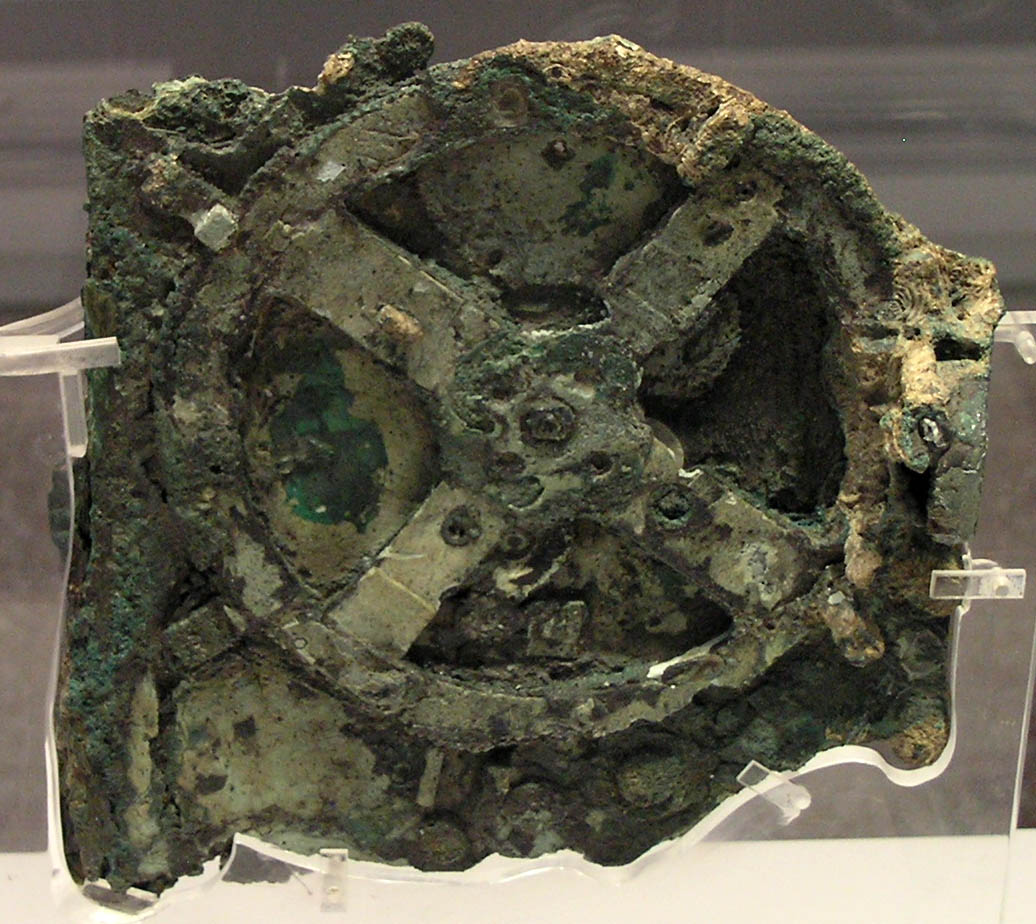
What they recovered was a corroded lump of bronze and wood, initially believed to be just another rock or perhaps a decorative piece. It was only after a few years, when the object began to break apart, that the intricate gears within became visible. This was no ordinary artifact. It was a complex mechanical device, now known as the Antikythera Mechanism, and it hailed from a ship that research places around the first century BCE. Its very existence posed a profound question: how could such advanced engineering exist in ancient Greece?
Unraveling the Gears of Time
The Antikythera Mechanism is often referred to as the world's first analog computer. This isn't hyperbole; the more scientists and researchers study it, the more astonishing its capabilities appear. The device, when reconstructed and understood, could predict astronomical positions and eclipses decades in advance. It tracked the movements of the moon, the sun, and likely several planets known at the time. It even accounted for the moon's irregular orbit, a sophisticated detail that speaks volumes about the astronomical and mechanical knowledge of its creators.
Initial studies by scholars like Derek J. de Solla Price in the 1950s and 60s revealed an astounding complexity. The mechanism housed a differential gear, a component not thought to have been invented until the 16th century. This specific gearing allowed it to model the varying speed of the moon across its elliptical path. Imagine, a hand-cranked device, built two millennia ago, capable of such precise calculations. It had multiple dials on its front and back, displaying various astronomical cycles, including the Saros cycle (for predicting eclipses) and the Metonic cycle (a period of 19 years after which the phases of the moon recur on the same days of the year).
Who Built Such a Marvel?
The exact identity of the mechanism's creator remains unknown, but theories abound. Given its sophistication and the level of astronomical knowledge embedded within it, many point towards prominent Greek mathematicians and astronomers. Archimedes, known for his mechanical genius, is a popular candidate, though the shipwreck dates to well after his lifetime. Others suggest Hipparchus, a renowned astronomer, or even Posidonius, a philosopher and polymath who resided on Rhodes, a significant center for astronomy at the time. The device's calendar, which included an Olympiad dial to track the four-year cycle of the ancient Olympic Games, further links it to Greek culture and knowledge.
The craftsmanship suggests a single workshop or a group of highly skilled artisans working under the direction of a brilliant mind. The bronze gears, some incredibly small and finely cut, were a testament to advanced metalworking techniques. It wasn't simply a collection of gears; it was a carefully calibrated system designed for a specific, complex purpose. This was a piece of precision engineering that wouldn't see its like again for over a thousand years.
Why Was It Lost, and Where Are Its Peers?
The Roman ship carrying the Antikythera Mechanism was likely transporting a diverse cargo, possibly looted treasures or luxury goods destined for Rome. The mechanism could have been an item of scientific curiosity, a teaching tool, or even a demonstration piece for a wealthy patron. Its loss in the shipwreck means we only have this single, incomplete example.
This raises one of the most persistent questions surrounding the Antikythera Mechanism: if such devices existed, why haven't we found others? Was this a singular masterpiece, or were similar machines more common than our archaeological record suggests? The fragility of bronze and the destructive power of time and seawater mean that many such items would simply not survive. It's possible that this mechanism is not an anomaly in terms of its existence, but rather an anomaly in its survival.
“The Antikythera Mechanism challenges our preconceptions about ancient technology, pushing the boundaries of what we thought was possible for the Greeks.”
Modern imaging techniques, like X-ray tomography, have allowed researchers to peer inside the corroded fragments without damaging them further. These studies continue to reveal new details, including previously unknown gearing arrangements and inscriptions that provide clues about its functions. Each new discovery reinforces the idea that the Antikythera Mechanism was not just a curiosity, but a sophisticated scientific instrument, a true marvel of ancient engineering.
The Antikythera Mechanism: A Glimpse into Ancient Ingenuity
The implications of the Antikythera Mechanism are profound. It demonstrates a level of technological and scientific understanding in the ancient world that many historians previously believed to be impossible. It pushes back the timeline for complex geared mechanisms by over a millennium. It shows us that ancient Greek civilization was not only capable of philosophy, art, and architecture, but also of intricate mechanical computation.
While the mechanism itself is now carefully preserved, its full story continues to unfold. There are still fragments being studied, and new interpretations of its functions are proposed. We may never know the name of its inventor, or how many other such devices existed. But what the Antikythera Mechanism definitively proves is that the human capacity for innovation and scientific inquiry is a thread that runs deep through history, often surprising us with its ancient roots. What else might lie hidden, waiting to redefine our understanding of the past?
Sources and further reading
- Scientists explain how the ancient Greek Antikythera Mechanism copied the Moon's changing speed without m - The Times of India
- An Animated Introduction to the Antikythera Mechanism: The World’s First Analog Computer from Ancient Greece - Open Culture
- The Antikythera mechanism: ancient Greek computer that predicted eclipses - Euronews.com
- The 2,000 year old Greek computer that defies modern engineering - Futura, le média qui explore le monde
- The Antikythera mechanism recovered from a Roman shipwreck in 1901 turned out to be a hand-cranked bronze computer that could predict eclipses and track the irregular orbit of the Moon, and nothing of comparable mechanical complexity would appear an - Space Daily
- What is the Antikythera mechanism? - Earth.com
- Background reference: The Antikythera mechanism
A factual retelling drawn from public reporting on a real case. Where a claim is unproven, it is flagged. Please verify with the linked sources.