
Lepakshi Temple's Floating Pillar: An Architectural Puzzle
Unexplained - ABikram Mondal
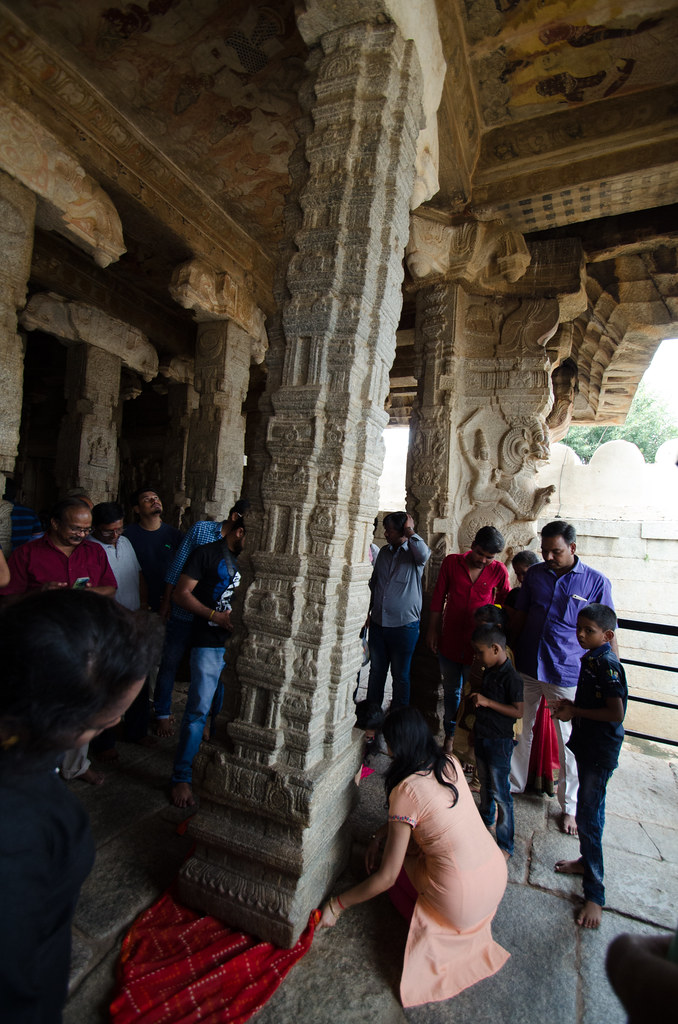
An Unseen Support in Stone
Walk through the Veerabhadra temple in Lepakshi, Andhra Pradesh, and you will find yourself surrounded by the intricate carvings and grand scale typical of Vijayanagara architecture. This 16th-century structure, dedicated to Lord Veerabhadra, is a site of immense historical and cultural significance. But amongst its many impressive features, there is one that routinely captures the attention of visitors and scholars alike: a pillar that appears to hang in the air, its base noticeably detached from the floor below.
It isn't a trick of the light, nor some modern installation. This is a genuine, centuries-old pillar, one of approximately seventy within the main mandapa. For generations, people have observed that a thin piece of cloth, or even a sheet of paper, can be passed completely underneath its base, demonstrating its lack of direct contact with the ground. This isn't a slight gap; it's enough to clearly show an absence of full structural support from below. It's an anomaly that has puzzled engineers and historians, earning it the name 'Aakaasa Sthambha', or the 'hanging pillar'.
The Craft of the Viswakarmas
The construction of the Veerabhadra temple is credited to Virupanna and Viranna, two brothers who served as governors under the Vijayanagara king Achutaraya. The architectural style here, a hallmark of the Vijayanagara empire, showcases incredible craftsmanship. The temple complex itself is vast, adorned with frescoes, sculptures, and detailed carvings that tell tales from the Puranas and depict various deities. The temple's location, shaped like a tortoise (Kurmasaila), also adds to its unique character, providing a panoramic view of the surrounding landscape.
The engineering behind the hanging pillar is often attributed to the Viswakarma sculptors and builders of that era. These artisans were renowned for their mastery over stone, their ability to combine artistic vision with complex structural understanding. How they managed to erect a massive stone pillar in such a way that it remains suspended, seemingly defying the fundamental principles of gravity, remains a subject of considerable discussion. It's not a small, decorative element but a substantial column that forms part of the temple's structural integrity.
Theories and Explorations
Naturally, a marvel like the hanging pillar has attracted its share of theories. One popular account suggests that during the British colonial period, a British engineer, eager to understand the secret behind the pillar's suspension, attempted to dislodge it. In doing so, according to local lore, he inadvertently caused a slight shift in the pillar's position, leading to a minor displacement of some other elements within the temple. This narrative, while widely circulated, lacks definitive historical documentation to fully corroborate it. What is certain, however, is that the pillar does, indeed, hang.
Modern engineers and architects who have studied the temple have proposed various explanations. Some suggest it might be a deliberate design feature, a demonstration of the builders' advanced understanding of load distribution and counterbalancing forces. The weight of the ceiling and other structural elements could be so precisely distributed that this particular pillar bears minimal downward force, or is even held in tension from above. Others speculate it could be a geological anomaly, where the ground beneath this specific point has settled over centuries, leaving the pillar suspended. However, the uniformity of the gap beneath the pillar makes a geological explanation less likely to be the sole reason.
Another theory suggests that the pillar was intentionally designed this way to showcase the exceptional skill of the architects. It's a testament to a sophisticated knowledge of statics and dynamics, allowing them to create an illusion or a genuine structural marvel that continues to mystify. The builders may have understood how to distribute weight across the other seventy pillars, effectively creating a cantilever effect or some other ingenious method that renders this one pillar largely decorative in its foundational role, despite its substantial size.
A Living Enigma
The Lepakshi Veerabhadra temple today is not just a historical site; it's an active place of worship and a significant tourist destination. Its unique architecture, including the hanging pillar, draws visitors from across India and beyond. There have been calls from historians and cultural bodies for the government to take steps towards getting the Lepakshi temple included in the UNESCO World Heritage list, recognizing its unparalleled historical and architectural value.
Teams from the G20 have also visited the site, expressing enthusiasm at the sight of the hanging pillar, underlining its global appeal as an architectural wonder. Newspapers and travel blogs frequently feature the temple, highlighting its 500-year-old mystery. It stands as a powerful reminder of the ingenuity of ancient Indian craftsmanship and engineering, a skill that could produce structures capable of defying conventional understanding for centuries.
The hanging pillar of Lepakshi continues to be a subject of fascination. Is it a deliberate engineering marvel, a carefully calculated display of architectural prowess? Or is it the result of unforeseen geological shifts over half a millennium? Perhaps the answer lies somewhere in between, a blend of expert craftsmanship and the subtle, slow dance of the earth. What precise method allowed the 16th-century builders to construct a stone column that simply… floats?
Sources and further reading
- Historian urges government to take steps to get Lepakshi temple included in UNESCO heritage list - The Hindu
- Lepakshi Temple: Time travel to the royal past, where every stone tells a story - telegraphindia.com
- Don’t miss the astonishing architecture and hanging pillars of the Lepakshi temple - The Statesman
- G20 team visits Lepakshi, enthused at sight of hanging pillar - Deccan Chronicle
- Andhra Pradesh: Lepakshi temple frontrunner to get Unesco heritage tag - The Times of India
- This 500-Year-Old Indian Temple Has A Pillar That Doesn't Touch The Ground - News18
- Background reference: The Lepakshi hanging pillar
A factual retelling drawn from public reporting on a real case. Where a claim is unproven, it is flagged. Please verify with the linked sources.