
Lepakshi's Hanging Pillar: An Enduring Architectural Anomaly
Unexplained - ABikram Mondal
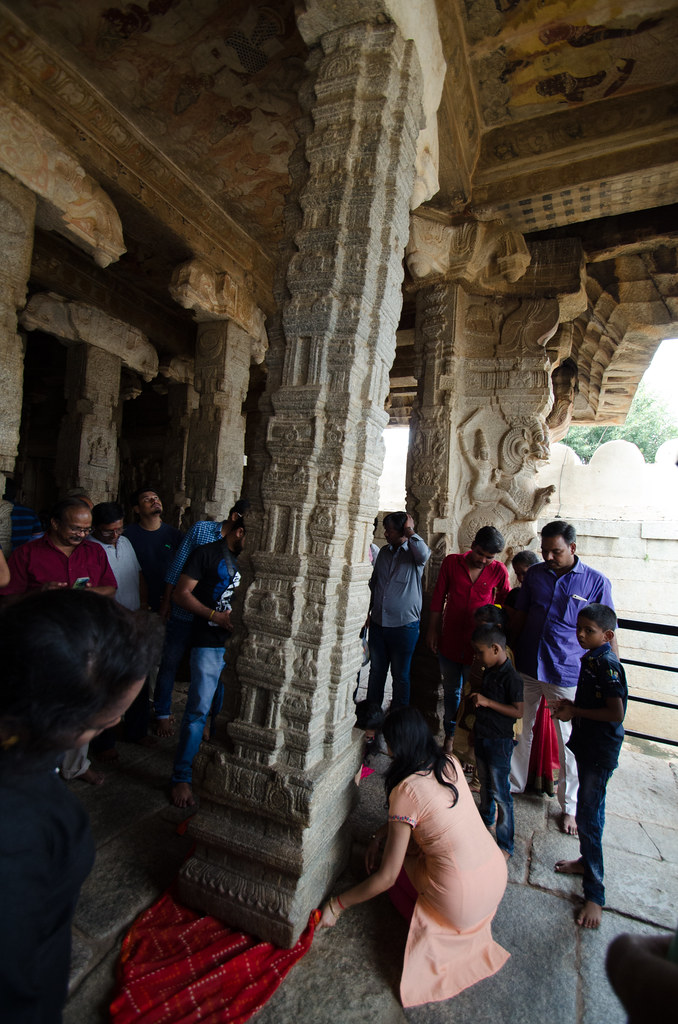
A Suspension in Stone
In the Anantapur district of Andhra Pradesh, near the Karnataka border, stands the Veerabhadra temple at Lepakshi. This complex, dating back to the 16th century and attributed to the Vijayanagara Empire, is a sprawling testament to intricate craftsmanship. Yet, among its many carvings and murals, one particular feature consistently draws visitors and historians alike: a pillar that seemingly floats.
It's not a trick of light or an optical illusion. Walk beneath it, and you’ll find ample space to pass a thin piece of cloth, a scarf, or even a sheet of paper from one side to the other. This isn't just a minor gap; the pillar, one of 70 supporting the temple's mandapa, is noticeably detached from the floor, resting on only one corner. It’s a genuine architectural anomaly, a point of fascination that has endured for centuries.
The Temple's Grand Design
The Veerabhadra temple itself is a masterpiece. Dedicated to Veerabhadra, a fierce incarnation of Shiva, it’s built in the Vijayanagara style, known for its elaborate sculptures and detailed iconography. Within its premises, one can find a massive monolithic Nandi (bull) statue, various shrines, and the famous frescoes depicting scenes from the Ramayana and Mahabharata. The entire site is currently a frontrunner for inclusion in the UNESCO World Heritage list, a recognition that would highlight its historical and cultural significance.
The temple's construction is generally credited to Virupanna and Viranna, two brothers who served as governors under the Vijayanagara king Achyuta Deva Raya. Their vision brought forth a structure that blends religious devotion with remarkable engineering. However, it's the specific design choice involving the hanging pillar that continues to spark conversation and theories.
The Engineering Question
How was it done? This is the primary question everyone asks upon seeing the Lepakshi hanging pillar. There are no obvious support mechanisms, no visible wires or hidden cantilevers. It simply appears to defy gravity, or at least, the conventional understanding of structural support.
One popular local legend attributes its construction to a divine hand, suggesting that it was a feat beyond human capability. This aligns with many ancient Indian architectural sites where advanced engineering often blurred the lines with spiritual belief. For many visitors, the pillar reinforces a sense of awe, prompting contemplation on the ingenuity of the past.
More grounded explanations typically lean towards a deliberate design choice, a demonstration of the builders' mastery. Some engineers suggest it might have been an intentional display of their skill in weight distribution and balance. The builders likely understood the precise distribution of load across the other pillars, allowing one to be offset in this manner. It could have been a calculated void, left intentionally to impress.
Another theory, often recounted by local guides, involves a British engineer during the colonial era. It's said that this engineer, skeptical of the pillar's ability to 'hang', attempted to dislodge it to prove it was a trick. In doing so, the story goes, he inadvertently caused a slight shift in the entire structure, which is why the pillar now hangs with a noticeable gap. While this makes for a compelling narrative, concrete historical documentation to support this specific incident is scarce. It remains largely in the realm of local lore, a tale passed down through generations.
A Living Mystery
Regardless of the exact method or intent, the Lepakshi hanging pillar remains an architectural marvel. It stands not as a ruin, but as a vibrant part of an active temple, visited by pilgrims and tourists daily. G20 delegates have recently toured the site, expressing enthusiasm for its unique features, highlighting its continued relevance and appeal.
The temple's pillars are not merely structural; they are intricately carved with figures of dancers, musicians, and deities, each telling a story. The hanging pillar, however, tells a different kind of story – one of ancient knowledge, precise execution, and perhaps, a touch of deliberate mystery. It challenges our assumptions about what was possible centuries ago, without the aid of modern tools or computational design.
Is it a testament to a lost architectural secret, a playful demonstration of skill, or a result of time and subtle shifts? The debate continues, adding another layer to the enduring mystique of the Veerabhadra temple. As the cloth passes freely beneath the stone, one can’t help but wonder about the minds that conceived and executed such a remarkable, gravity-defying feat.
Sources and further reading
- Lepakshi Temple: Time travel to the royal past, where every stone tells a story - telegraphindia.com
- Historian urges government to take steps to get Lepakshi temple included in UNESCO heritage list - The Hindu
- Don’t miss the astonishing architecture and hanging pillars of the Lepakshi temple - The Statesman
- G20 team visits Lepakshi, enthused at sight of hanging pillar - Deccan Chronicle
- Andhra Pradesh: Lepakshi temple frontrunner to get Unesco heritage tag - The Times of India
- Lepakshi: an underrated marvel hidden in plain sight - PressReader
- Background reference: The Lepakshi hanging pillar
A factual retelling drawn from public reporting on a real case. Where a claim is unproven, it is flagged. Please verify with the linked sources.