
When a Black Hole Becomes a Star: What Does the Cosmos Teach Vairagya?
2026-08-18 - ABikram Mondal
The Quiet Hum of a Distant Discovery
It was late. Past two in the morning, the kind of quiet that settles over our Kolkata flat after a long day of debugging code and sifting through network logs. My client, a small NGO helping rural artisans sell their wares online, had a critical payment gateway bug. I’d just pushed the fix, the kind of fix that makes you sigh with relief. Then, a notification popped up on my personal feed: ‘Astronomers discover a new kind of cosmic object – a black hole ‘star’.’
A black hole star. The words felt like a riddle. A black hole, by its very nature, consumes. A star, by its very nature, radiates. How could these two be one? My mind, usually sifting through IP addresses and encryption protocols, paused. This wasn't about terrestrial networks or digital vulnerabilities. This was about the fundamental nature of existence, seen through a cosmic lens. It’s what astronomy, in its vast, indifferent way, always does to me. It pulls me out of the immediate, the urgent, and reminds me of a scale far beyond human worries.
For a vairagi, one who strives for detachment, such news isn't a call to excitement or intellectual ownership. It's a gentle nudge towards the impermanence of our categories, our labels. We build systems, both physical and conceptual. We name things: star, planet, black hole. And then the universe, with a quiet shrug, shows us something that defies our neat boxes. A black hole star. It's beautiful, isn't it? The universe doesn't care for our definitions.
What Even is a 'Black Hole Star'?
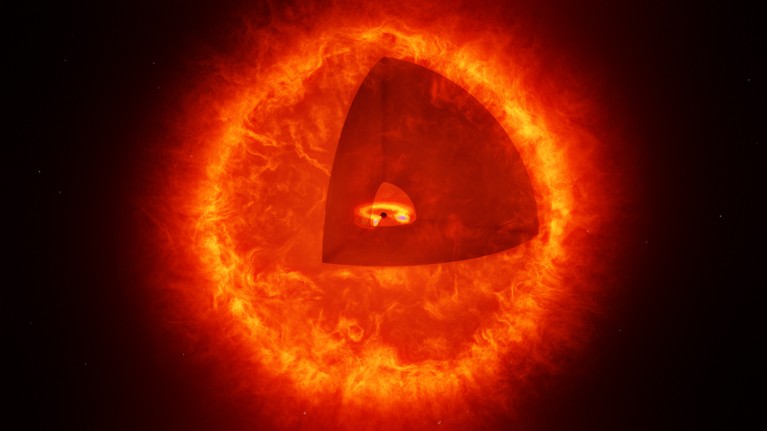
The concept itself is fascinating, if a little mind-bending. Imagine a star, not burning hydrogen and helium in its core, but rather having a small black hole at its center, accreting matter from the star's own gas. This accretion would release enormous amounts of energy, preventing the star from collapsing and causing it to shine. So, it's a star, yes, but powered by the very thing we thought only consumed. It's a cosmic paradox, a living oxymoron.
My work often deals with paradoxes too, though on a much smaller scale. Cybersecurity, for instance. You build a fortress of firewalls and intrusion detection systems, thinking you've secured everything. Then a new vulnerability emerges, a zero-day exploit that defies all your existing defenses. The 'unbreakable' system suddenly has a crack. You realize that security, like knowledge of the cosmos, is a constant process, never a final state. There's always something new, something that twists your understanding.
This 'black hole star' discovery, if confirmed, challenges our very models of stellar evolution. It implies a whole new pathway for how stars live and die. It suggests that what we thought we knew, even about the most fundamental objects in the sky, might just be a small part of a much grander, stranger story.
Looking Inward When the Cosmos Expands
When I first started down the path of vairagya, I thought it meant shedding all interest in the world. Renouncing, turning away. But I’ve come to understand it differently. It's not about ignoring the world, but about observing it without clinging. Seeing the wonder without needing to possess the knowledge, or even to fully comprehend it. It's about letting the mind be a clear mirror, reflecting what is, without distorting it with desire or fear.
Looking up at the night sky, especially after a discovery like a black hole star, helps with this. It shrinks the ego. The endless expanse, the unimaginable forces at play, the sheer indifference of it all to our human dramas. A bug in a payment gateway, though critical to my client, seems like a fleeting whisper against the roar of a star powered by a black hole. It’s a perspective shift that’s both humbling and freeing.
I remember one night, I was on a client call, explaining a complex network architecture. The client kept interrupting, worried about the smallest detail. I found myself getting frustrated. Later that night, I went to the ghats by the Ganges. The river flowed on, ancient and unhurried. Above, the stars were out, a million pinpricks of light. That’s when it hit me: my frustration came from attachment. Attachment to my own explanation, to the client’s understanding. The river, the stars, they simply are. They don't demand comprehension or approval. They just exist. And in that existence, there's a profound teaching.
Does Detachment Dull Our Curiosity?
Some might think that cultivating vairagya would make one less curious, less engaged with scientific discovery. Why bother with black hole stars if you're meant to be detached from worldly concerns? But for me, it's the opposite. True detachment isn't apathy. It's an open-hearted curiosity, unburdened by the need to prove, to possess, or to be right. It's the joy of observation for its own sake.
When I read about this new kind of cosmic object, I don't feel a need to add it to my mental inventory of 'facts'. I don't feel a need to debate its implications or to stake a claim on its meaning. Instead, I feel a sense of wonder. A simple, pure wonder that something so astonishing could exist. It’s a reminder that the universe is endlessly creative, endlessly surprising. Our models, our theories, our neatly categorized understanding – they are always provisional, always subject to revision. And that's a beautiful thing. It keeps us awake, keeps us looking, keeps us questioning.
What else is out there, beyond our current understanding? What other cosmic oddities are waiting to be revealed? And what new ways will the universe find to remind us of the vastness, the mystery, and the beautiful, unsettling truth of not knowing everything?